
Your comprehensive financial plan is finished. Congratulations! You’ve spent weeks gathering tax returns, investment statements, retirement account balances, insurance information, and estate planning documents. You’ve had thoughtful conversations about your goals, discussed retirement, reviewed cash flow, evaluated taxes and investments, considered estate planning, insurance, and legacy goals. The day has finally arrived. Your financial advisor hands you a beautifully organized financial plan. It’s personalized, comprehensive, and built around everything you know to be true today. Every recommendation has been thoughtfully designed to reflect your life, your goals, and your financial picture at this moment in time.
What’s Next?
Many people assume the hard part is creating the financial plan – and they’re right. Creating a comprehensive financial plan is no small undertaking. It requires thoughtful analysis, careful coordination, and personalized recommendations across every aspect of your financial life. But the plan is only the beginning. The long-term value comes from thoughtfully implementing those recommendations, monitoring your progress, and adapting your strategy as markets, tax laws, and life itself continue to change.
Can a Financial Plan Change Over Time?
Yes, in fact, a financial plan should change over time. A well-crafted financial plan can provide clarity, direction, and confidence. It can also help answer many questions surrounding areas like saving, spending, retirement, investing, life insurance, tax strategies, and estate planning. But financial planning was never intended to be a one-time event, and the real value comes from putting those recommendations into action, monitoring your progress, and making thoughtful adjustments as your life evolves.
When Should You Update Your Financial Plan?
Even if nothing dramatic has changed, it’s still wise to review your financial plan regularly. Annual or semiannual reviews help ensure your investments remain aligned with your goals, your tax strategies are still appropriate, your estate documents are current, and you’re taking advantage of new planning opportunities as they arise.
Think back just five years ago. Interest rates and tax laws looked different, inflation was lower, and markets experienced periods of extraordinary volatility. Your own life has likely changed in ways you couldn’t have predicted, too. That’s why financial planning is designed to evolve over time. The recommendations that made sense when your plan was created may deserve another look after a major life event or a meaningful shift in the economy. Rather than starting over each year, the goal is to periodically revisit your plan, so it continues to reflect your life, your priorities, and the goals that matter most.
Sometimes the biggest changes aren’t happening in Washington or on Wall Street. They’re happening around your kitchen table. A child decides to attend graduate school, or a parent needs long-term care. You retire earlier than expected, move closer to family, purchase a second home, or decide to leave a larger charitable legacy. These moments often have a greater impact on your financial plan than the market itself.
While every situation is different, the following personal, financial, legislative, and market events are all good reasons to revisit your financial plan:
- A marriage, divorce, or the loss of a spouse
- The birth or adoption of a child or grandchild
- A career change, promotion, or job loss
- Starting, growing, or selling a business
- Receiving an inheritance or other financial windfall
- Purchasing or selling a home or vacation property
- Caring for aging parents or planning for long-term care
- Approaching retirement or deciding to retire earlier or later than expected
- Significant changes in tax laws or retirement legislation
- Major market events that affect your investments or retirement income strategy
- A shift in your goals, priorities, risk tolerance, or lifestyle
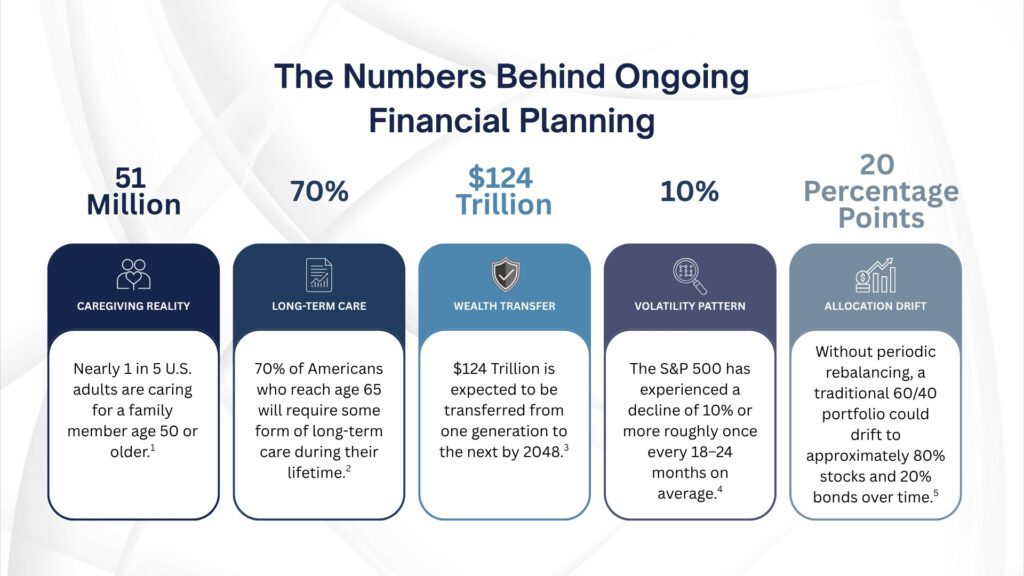
These aren’t “rare” events reserved for “someone else.” They happen every day, and many of them impact millions of Americans each year. The numbers help put their impact into perspective.
How Do You Put a Financial Plan into Action?
Putting a financial plan into action begins with turning its recommendations into clear, prioritized steps. Your plan may call for increasing retirement contributions, diversifying a concentrated stock position, updating estate documents, refinancing debt, adjusting your investment allocation, or completing annual Roth conversions. Those recommendations do not happen automatically. Someone needs to determine what should happen first, monitor important deadlines, coordinate with attorneys and accountants when appropriate, and evaluate new opportunities as they arise.
Implementation also continues beyond the initial checklist. Your financial plan will not alert you when tax laws change, recognize that your tolerance for investment risk has shifted, or remind you to revisit beneficiaries after a major family milestone. It cannot determine on its own whether a market decline, career change, or approaching retirement date should lead to an adjustment.
That is why putting a financial plan into action is an ongoing process. It involves following through on recommendations, monitoring your progress, revisiting decisions as circumstances change, and keeping your long-term goals at the center of each financial choice.
How Often Should You Review Your Investment Strategy?
For most investors, reviewing your investment strategy at least once a year is a good starting point. An annual review provides an opportunity to evaluate whether your portfolio still aligns with your goals, time horizon, cash flow needs, and tolerance for risk. Investment management is about much more than selecting a portfolio and letting it run. Over time, portfolios drift from their intended allocation, tax-loss harvesting opportunities emerge, Roth conversion opportunities may arise, and Required Minimum Distribution rules change. Cash flow needs can evolve, and your tolerance for risk tends to shift as retirement approaches.
The goal isn’t to react to every market headline or make frequent changes to your investments. Instead, you’ll need to ensure your strategy continues to support the life you’re building.
During an investment strategy review, consider questions such as:
- Has my financial situation changed?
- Have my goals or priorities changed?
- Has my time horizon become shorter?
- Am I still comfortable with the amount of investment risk I’m taking?
- Has my portfolio drifted from its target allocation?
- Are there tax planning opportunities or legislative changes I should consider?
Regular reviews also provide an opportunity to step back from the day-to-day noise of the markets. Headlines can test even the most disciplined investors, but history has repeatedly shown that emotional decisions made during periods of uncertainty can have lasting consequences. Having a trusted advisor to provide perspective, revisit your plan, and help keep emotions from driving important financial decisions can be just as valuable as the recommendations themselves.
Do You Need Ongoing Financial Planning?
Research consistently reveals that many of the benefits of working with a financial advisor extend well beyond investment selection. According to Vanguard, investors who work with an advisor report greater peace of mind, lower financial stress, and meaningful time savings compared with those who manage everything on their own. In fact:
- 86% say working with an advisor provides greater peace of mind.
- 76% say having an advisor saves them time.
- On average, advised investors report saving approximately two hours each week by having a trusted professional help manage their financial affairs.
Morningstar has similarly found that some of the greatest value advisors provide comes from retirement income planning, tax-efficient withdrawal strategies, behavioral coaching, portfolio rebalancing, and other planning decisions, not simply selecting investments.
In other words, the value of an ongoing advisory relationship often comes from helping clients make better financial decisions over time.
What Is a Living Financial Plan?
We don’t view a financial plan as a document that’s created, delivered, and placed on a shelf. We view it as a living framework that should evolve alongside your life.
That’s why our ongoing planning process includes regular financial strategy sessions, portfolio reviews, retirement projections, tax planning discussions, estate planning coordination, and conversations about the life events that don’t fit neatly into a spreadsheet. Whether you’re approaching retirement, navigating a career change, selling a business, welcoming a new grandchild, or simply wondering if you’re still on track, your financial plan should continue to adapt as your circumstances change.
Why Does Financial Planning Continue After the Plan Is Finished?
Receiving your financial plan is certainly worth celebrating. It represents one of the most important investments you can make in your future. It took a tremendous amount of work, thoughtful analysis, and a clear vision for what you want your life to look like. Its value continues long after the plan is delivered, through the decisions you make, the progress you measure, and the thoughtful adjustments that help keep your financial life aligned with your goals.
But creating a financial plan isn’t the finish line, and it’s not the last chapter. It’s day one. The real journey begins the very next morning. No one has a crystal ball, and we can’t predict exactly what life will bring, but having a thoughtful plan, and someone to help you adapt as life unfolds, can help turn your goals into reality while providing lasting confidence and peace of mind. Life doesn’t stand still and your financial plan shouldn’t either.
For tailored, fee-only guidance on managing your wealth or questions about investment strategies, please contact our team of CERTIFIED FINANCIAL PLANNERTM (CFP®) professionals for a complimentary discovery call at 631.218.0077, or click here. We would be happy to show you how our financial planning process can help you stay on track and achieve your financial goals. You can also send us a message directly.
R.W. Rogé & Company, Inc. is an independent, fee-only financial planning and investment management firm serving clients locally and virtually across the country, with Long Island, New York, and Beverly, Massachusetts office locations. R.W. Rogé & Company, Inc. was founded on a “client first” culture and proudly commits to acting in your best interest as a fiduciary. We have helped clients Plan, Achieve, and Live® the life they want since 1986. To learn more about how we do this, as well as our process, explore our detailed overview of services and approach.
Sources:
1. AARP
2. ACL
3. Cerulli Associates
4. Fidelity
5. Vanguard